Research reveals oral health problems in patients with metabolic fatty liver disease
03 February 2026
People with metabolic dysfunction-associated steatotic liver disease (MASLD), formerly referred to as non-alcoholic fatty liver disease (NAFLD), are more aware of oral problems than healthy individuals and have significant differences in oral hygiene, according to a new study.
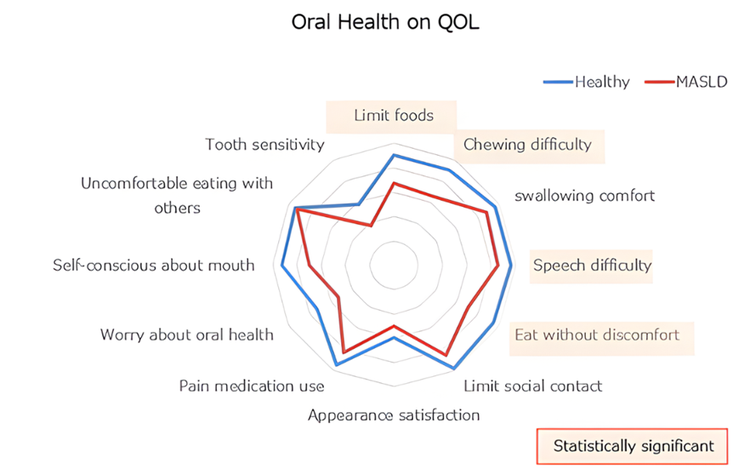
The research, carried out by international oral health company, Sunstar, in collaboration with Jichi Medical University and published in Clinical and Experimental Hepatology analyzed the relationship between oral conditions and related difficulties in people with MASLD. These patients were found to be more aware of oral problems such as the “inability to chew” and “difficulty speaking as intended”, affecting their quality of life (QOL).
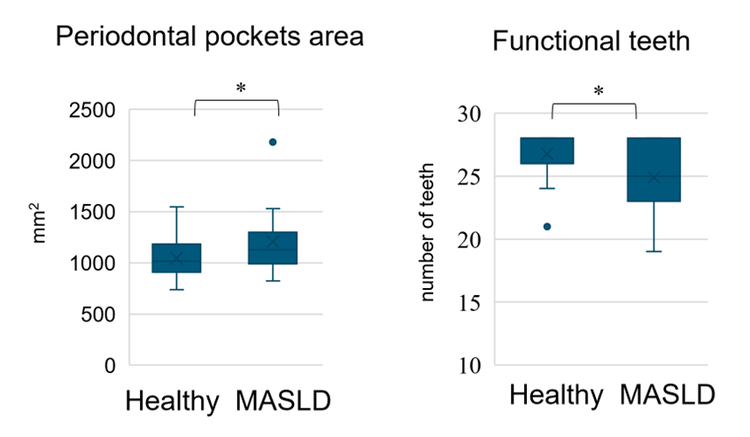
While oral examinations showed no statistically significant differences in eating ability, tongue strength, or pronunciation, significant differences were found in oral hygiene, caries, periodontal disease status, and the number of teeth that could chew properly. Even after adjusting for age, gender, and obesity, there was a significant association between MASLD and both periodontal disease and the number of functional teeth.
These findings indicate that MASLD is associated not only with periodontal disease, but also with oral functions such as the number of teeth that can chew properly, highlighting the importance of maintaining oral health.
Research Overview
Background and Purpose
Due to the westernization of eating habits and the increase in obesity, it is estimated that more than 20 million people in Japan have fatty liver disease1. MASLD is caused by having too much fat in the liver and is closely related to lifestyle diseases and metabolic disorders. It also carries a high risk of progression to cirrhosis and liver cancer, making prevention extremely important.
Previous studies have shown a link between NAFLD (Non-Alcoholic Fatty Liver Disease) and periodontal disease, but there have been no reports on the relationship with oral function. It was for this reason that Sunstar and Jichi Medical University conducted a study analyzing the relationship between MASLD and oral conditions and functions in people diagnosed with the new disease concept, compared to healthy individuals.
Subjects and Methods
The study targeted 19 MASLD patients (average age 54.1 years) attending Jichi Medical University Hospital and 26 healthy individuals (average age 48.4 years). MASLD was defined based on the criteria of the new concept of fatty liver2 and diagnosed using ultrasound. Healthy individuals were recruited at Jichi Medical Health Check-up center and Sunstar employees, who did not receive any medications.
The impact of oral problems on QOL was assessed using the General Oral Health Assessment Index (GOHAI)3 via questionnaire. Oral examinations measured oral hygiene (plaque, tartar, tongue coating), cavities (DMFT)4, periodontal disease (depth and area of periodontal pockets, area of periodontal inflammation, bleeding on probing), and oral function (number of teeth, number of functional teeth5, chewing ability, tongue pressure, oral dexterity6, saliva secretion) by dentists and dental hygienists.
Statistical analysis was performed to determine significant differences in GOHAI and oral examination results between MASLD patients and healthy individuals. Regression analysis was also conducted to examine the association between MASLD and oral conditions/functions, adjusting for age, gender, and obesity (BMI).
Research Results
1. Impact of Oral Problems on QOL
Using GOHAI, the impact of oral problems on QOL was evaluated. MASLD patients were found to be significantly more affected than healthy individuals, especially in functional aspects such as eating and conversation (Figure 1).
2. Relationship Between MASLD, Periodontal Disease, and Oral Function
Whilst comparing oral conditions between MASLD patients and healthy individuals, statistically significant differences were found in oral hygiene, cavities, and periodontal disease status (periodontal disease: Figure 2). Among oral functions, no significant differences were found in chewing ability, tongue pressure, or oral dexterity, but significant differences were found in the number of functional teeth and saliva secretion (functional teeth: Figure 2).
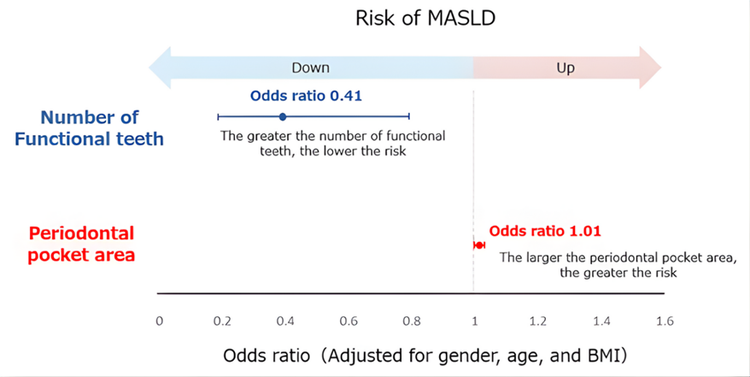
Even after adjusting for age, gender, and obesity, MASLD was independently and significantly associated with periodontal disease and the number of functional teeth. For each 1 mm² increase in periodontal pocket area, the odds ratio for having MASLD increased by 1.01, and for each additional functional tooth, the odds ratio decreased by 0.41 (Figure 3). This means that larger periodontal pocket areas increase the risk of MASLD, while more functional teeth lower the risk.
Conclusion
This study showed that MASLD patients experience a greater impact on daily life due to oral problems compared to healthy individuals. It also revealed that improved oral health lowers the risk of MASLD, emphasizing the importance of maintaining oral health for prevention. Not only periodontal disease, which has previously been linked to fatty liver diseases such as NAFLD, but also the number of teeth that can chew properly were found to be significantly related, suggesting the importance of maintaining oral function.
MASLD patients tend to have poor oral cleanliness and in addition to periodontal disease, show signs of QOL impact due to oral problems, indicating that oral care may become an important perspective. In the future, collaboration between medical and dental fields is expected to support both ‘body’ and ‘mouth’ in new forms of medical and health care.
Comments Dr. Kouichi Miura, Jichi Medical University, Department of Medicine, Division of Gastroenterology: “Recent studies have reported that oral health is related to various diseases. There have been several reports linking periodontal disease to fatty liver, but few have examined its impact on oral function and quality of life. This study clarified that MASLD patients experience various oral problems. The findings suggest that oral care will be important in the treatment of MASLD.”
Publication Information: Title: Oral health-related quality of life and oral function in patients with metabolic dysfunction associated steatotic liver disease. Journal: Clinical and Experimental Hepatology. DOI: https://doi.org/10.5114/ceh.2025.154497.Authors: Kouichi Miura, Naoshi Arai, Miki Ishikawa, Takako Yasuda, Nobue Wakabayashi, Aki Yamamoto, Yoshiyuki Mori, Kyoko Nakao, Hironori Yamamoto, Kazuhiko Kotani
¹ NAFLD/NASH Clinical Practice Guidelines, November 2020 (Japan Society of Gastroenterology)
² A new definition for metabolic dysfunction-associated fatty liver disease: An international expert consensus statement. Eslam M, Newsome PN, Sarin SK, et al. Hepatol 2020; 73: 202―209
³ GOHAI: A method for assessing how oral health affects daily life and psychosocial aspects. It consists of 12 questions covering functional aspects (eating, conversation), psychosocial aspects (appearance and confidence in public), and pain/discomfort.
⁴ DMFT: An index showing the total number of teeth with cavities experienced (untreated, extracted, or treated teeth). 4 Number of functional teeth: Teeth that actually function. Loose teeth, teeth with only roots remaining, dentures, implants, and bridges are not included.
⁵ Oral dexterity: Assessed by how quickly the sounds “pa,” “ta,” and “ka” can be repeated. “Pa” reflects lip movement, “ta” reflects the tip of the tongue, and “ka” reflects the back of the tongue. The number of repetitions in 5 seconds is measured as an indicator of oral dexterity.